
“
Clear football intelligence without the noise.
Mathic Field explains football beyond the final result. We track match analysis, player movement, referee impact, standings pressure, and tactical signals in one football intelligence dashboard.
Therefore, every match is viewed through context, momentum, and decision-making. Instead of only showing what happened, we explain why the game changed.
Pressure rises after a tactical substitution.
Also, a central overload creates attacking threat.
As a result, late momentum changes the match rhythm.
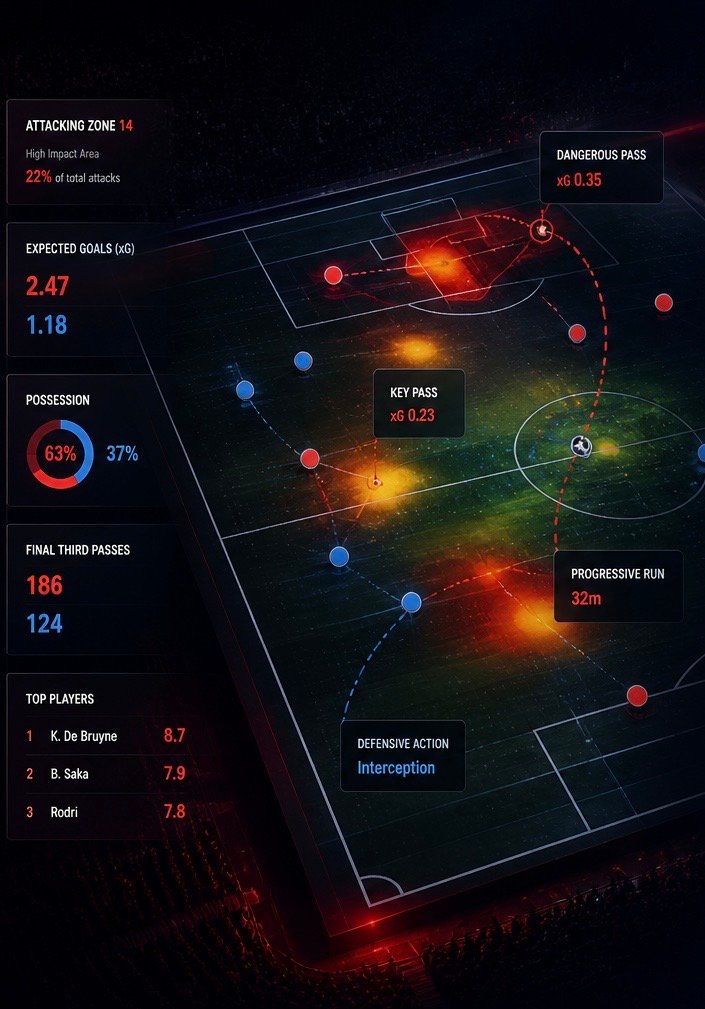
Momentum, pressure, possession flow, and attacking surges — explained visually by Mathic Field
Expert Insights • Tactical Depth • Data Narratives
Welcome to the tactical core of Mathic Field. We look beyond raw numbers, scoreboards, and simple match results.
Instead, this layer explains the structure behind the game. It turns match dynamics into clear football intelligence.
We decode formations, pressure zones, referee patterns, and momentum shifts. Also, we focus on the decisions that change match rhythm.
As a result, every insight is built to improve understanding, not add noise. This is where football data becomes structured analysis.
Football is not only goals, tables, or final results. Instead, Mathic Field reads the pressure, movement, decisions, and context behind the match.
Therefore, each area of the platform gives readers a faster route into football intelligence.
Read momentum, xG logic, pressure shifts, and the story behind the result.
02Explore Indonesian football signals, regional identity, and tactical context.
03Follow table movement, title pressure, survival tension, and form impact.
04Study player movement, decisions, timing, and influence beyond basic stats.
05Understand cards, VAR moments, pressure calls, and rhythm-changing decisions.
Modern football analysis is not only about goals, assists, or ratings. A player can control a match without dominating the scoreboard.
Instead, movement, timing, spacing, pressing discipline, and decision-making often explain more than the final numbers.
Also, the best players are not always the loudest players on the pitch. Some influence the game by receiving under pressure or opening passing lanes.
As a result, player analysis must look at tempo, positioning, and the choices that force opponents into uncomfortable decisions.
Mathic Field reads player performance through context.
We study how a player receives pressure, creates passing angles, breaks defensive lines, supports transitions, and changes match rhythm.
Therefore, the real question is not only what the player did. The key question is why it mattered inside the structure of the game.
Continue ReadingMathic Field reads football through context. Goals matter, but pressure, timing, player roles, referee decisions, and tactical risk often explain why a match changes. Therefore, the model connects data with the real story inside the game.
Momentum, pressure, transitions, and decisive sequences show why a match changed. As a result, the story becomes clearer.
Influence is not only goals or assists. Instead, movement, spacing, decisions, and rhythm show the deeper value.
Refereeing can change tempo, risk, and emotion. Also, cards, fouls, and VAR moments can shift control.
The model starts with data. However, numbers alone do not explain football.
A team can dominate possession and still lose control. So we read the situation behind the numbers.
Mathic Field asks sharper questions. Which team controlled the dangerous zones? Which phase created the biggest threat?
In addition, we study substitutions, player roles, and referee decisions. These details change the risk profile.
Match Analysis explains game movement. Player Analysis explains individual influence. Referee Intelligence explains control.
Meanwhile, Standing Intelligence explains what the table shows and what it hides. MF Nusantara applies the same lens to Indonesian football.
Mathic Field is not a normal football news feed. It is a football intelligence platform.
Because of that, the goal is simple: make football easier to understand without losing the emotion of the game.
The score tells the outcome. However, Mathic Field explains the mechanism behind it. The model connects data, tactics, momentum, player behavior, referee context, and table movement.
Mathic Field gives football readers a cleaner way to read the game. Instead of only following results, readers can scan match context, tactical pressure, referee impact, and table movement. As a result, football becomes easier to understand.
Clear football intelligence without the noise.
A sharper way to connect actions with pressure.
Referee decisions become part of the match story.
Standings feel clearer with performance context.
Clean structure, fast reading, strong identity.
We read referee influence through decision frequency, card volume, foul rhythm, penalty signals, and VAR interruptions.
However, this is not a verdict on the referee. It is a structured way to understand officiating pressure inside the match.
No. Mathic Field does not promise guaranteed outcomes.
Instead, we use football signals to support clearer interpretation. The goal is to read probability, context, form movement, pressure zones, and tactical patterns.
Cards, penalties, injury time, and match control can affect momentum. As a result, they can also influence points and table movement.
The standing layer connects those moments with broader performance context. This helps readers understand table movement beyond only wins and losses.
However, football is not explained by one number. Therefore, Mathic Field connects data with match context. Also, readers can understand pressure, rhythm, and tactical change faster.
For example, a player can influence a match without scoring. In addition, referee decisions can change tempo, risk, and control. As a result, the match story becomes easier to read.
Because standings do not show every detail, Mathic Field explains what the table reveals and what it hides. Instead of only showing results, the platform shows why football moments matter.
Football data context can also be supported by sports data services such as Sportmonks .