
Overview of Spain’s 2026 World Cup Journey
Spain completed a historic 2026 FIFA World Cup campaign by defeating Argentina 1–0 after extra time in the final. The result delivered Spain’s second men’s world title and confirmed the development of a team built around positional discipline, intelligent possession and collective control. Readers can follow the wider tournament picture through the Mathic Field standings and tournament intelligence.
Spain’s journey was not simply a sequence of victories. It was a demonstration of how tactical structure can remain stable while individual roles change during difficult matches. The team combined experienced leaders with technically strong younger players, allowing it to control the ball without becoming predictable. This principle is also explored in our Match Analysis section, where results are evaluated through momentum, positioning and decisive match events.
According to the official FIFA World Cup final report , Spain secured the championship against Argentina in front of more than 80,000 spectators at New York New Jersey Stadium. The narrow scoreline reflected the intensity of the final, but Spain’s control of territory and possession created the platform for the decisive extra-time moment.
Spain’s Tactical Identity
Spain’s tactical strength came from its ability to create numerical superiority around the ball. Rather than relying only on long periods of possession, the team used short passing combinations to attract opponents into central areas before progressing through the wings or half-spaces.
The positioning of Spain’s midfielders was fundamental. Players moved between the opposition’s defensive and midfield lines, forcing defenders to decide whether to step forward or protect the space behind them. These movements created passing lanes and helped Spain maintain pressure after losing possession. Similar positional patterns can be studied through Mathic Field Player Analysis.
Spain also demonstrated an effective counter-press. When possession was lost, nearby players immediately closed the ball carrier while the defensive line moved forward. This reduced the opponent’s time to launch counter-attacks and allowed Spain to recover the ball in advanced areas.
The Midfield Control Behind the Victory
Spain’s championship was driven by collective midfield control rather than the influence of one superstar. The midfield established the rhythm of matches, protected the defensive structure and helped the attacking players receive the ball in favourable positions.
Rodri’s tournament performances became central to this structure. His ability to receive under pressure, circulate possession and close transition spaces allowed Spain’s more attacking players to operate with greater freedom. Reports following the tournament identified him as the winner of the World Cup Golden Ball, recognising his influence across Spain’s campaign.
However, Spain’s midfield success was not produced by Rodri alone. The rotations around him were equally important. When one midfielder advanced, another player provided protection behind the ball. This balance prevented Spain from becoming exposed when attacks broke down.
Key Matches and Tactical Adjustments
Spain’s progression through the knockout rounds demonstrated tactical adaptability. The team did not approach every opponent with an identical plan. Against aggressive pressing teams, Spain used deeper build-up positions to create space behind the first pressure line. Against defensive opponents, the full-backs and wide attackers stretched the pitch to open central channels.
In the semifinal against France, Spain’s organisation helped neutralise one of the tournament’s most dangerous attacking teams. Spain controlled important central areas and prevented France from consistently attacking through open transitions. The 2–0 victory secured Spain’s place in the final and demonstrated the effectiveness of its defensive rest structure.
The final against Argentina created a different strategic challenge. Argentina defended with intensity and attempted to disrupt Spain’s passing rhythm. Spain remained patient, continued circulating the ball and avoided forcing low-quality attacks. After Argentina was reduced to ten players, Spain increased the pressure and eventually scored the decisive goal during extra time.
For deeper evaluation of match-changing incidents, tactical substitutions and momentum shifts, visit the Mathic Field Match Decision Outlook.
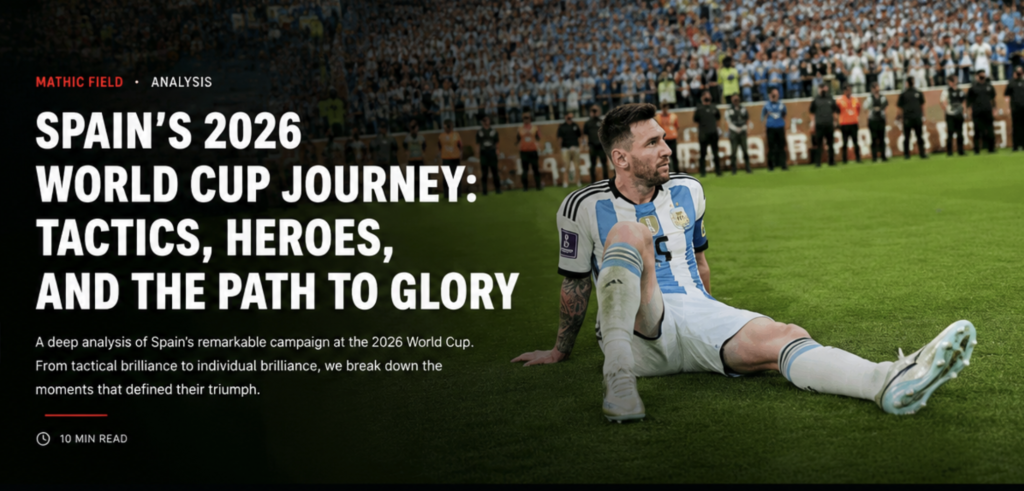
Messi’s Role for Argentina
Lionel Messi did not represent Spain during the tournament. He captained and played for Argentina, the defending champions and Spain’s opponent in the final. FIFA’s official Lionel Messi profile identifies him as Argentina’s number ten and long-standing national-team leader.
From Argentina’s perspective, Messi remained an important creative reference. His positioning between midfield and attack required Spain to remain compact and carefully manage the spaces around him. Spain’s defensive organisation prevented Argentina from consistently finding Messi in positions where he could turn and attack the final line.
This distinction is essential for an accurate tactical article: Messi’s influence formed part of Argentina’s attacking strategy, while Spain’s victory was produced by the tactical system implemented by its own coaching staff and players.
Defensive Discipline and Game Management
Spain’s attacking quality attracted much of the attention, but its defensive discipline was equally significant. The team protected the centre, maintained compact distances between the lines and controlled the zones from which opponents could counter-attack.
The defensive line worked in coordination with the midfield rather than operating as a separate unit. When Spain pressed higher, the defenders advanced to reduce the available playing area. When the press was broken, the team quickly recovered into a more compact shape.
Refereeing decisions and disciplinary moments also influenced the final. These elements can fundamentally change tactical risk and match behaviour. Mathic Field examines this dimension through its Referee Intelligence reports.
What Spain’s Victory Means for Future Tournaments
Spain’s title provides a modern blueprint for international football. Successful teams need more than technical quality; they require coordinated pressing, positional flexibility and the ability to manage different phases of a match.
The campaign also demonstrated the value of integrating younger players into a clearly defined tactical structure. Young talent can contribute immediately when responsibilities are precise and experienced players provide balance around them.
Future opponents will study how Spain created overloads, protected defensive transitions and maintained composure during high-pressure knockout matches. As tactical preparation evolves, teams may develop more aggressive pressing schemes or deeper defensive blocks specifically designed to disrupt Spain’s positional rhythm.
These principles also have relevance beyond European football. Our MF Nusantara analysis explores how global tactical concepts can be interpreted within Indonesian football, player development and domestic competition.
Final Mathic Field Assessment
Spain’s 2026 World Cup victory was not the achievement of a single player. It was the outcome of coordinated positioning, midfield authority, defensive discipline and intelligent game management.
The decisive lesson is clear: possession becomes valuable only when it changes the opponent’s structure. Spain circulated the ball to move defenders, open strategic spaces and maintain control over transitions. That combination made Spain the most complete tactical unit at the tournament.
Continue exploring football through data, tactics and match context in the Mathic Field intelligence platform.