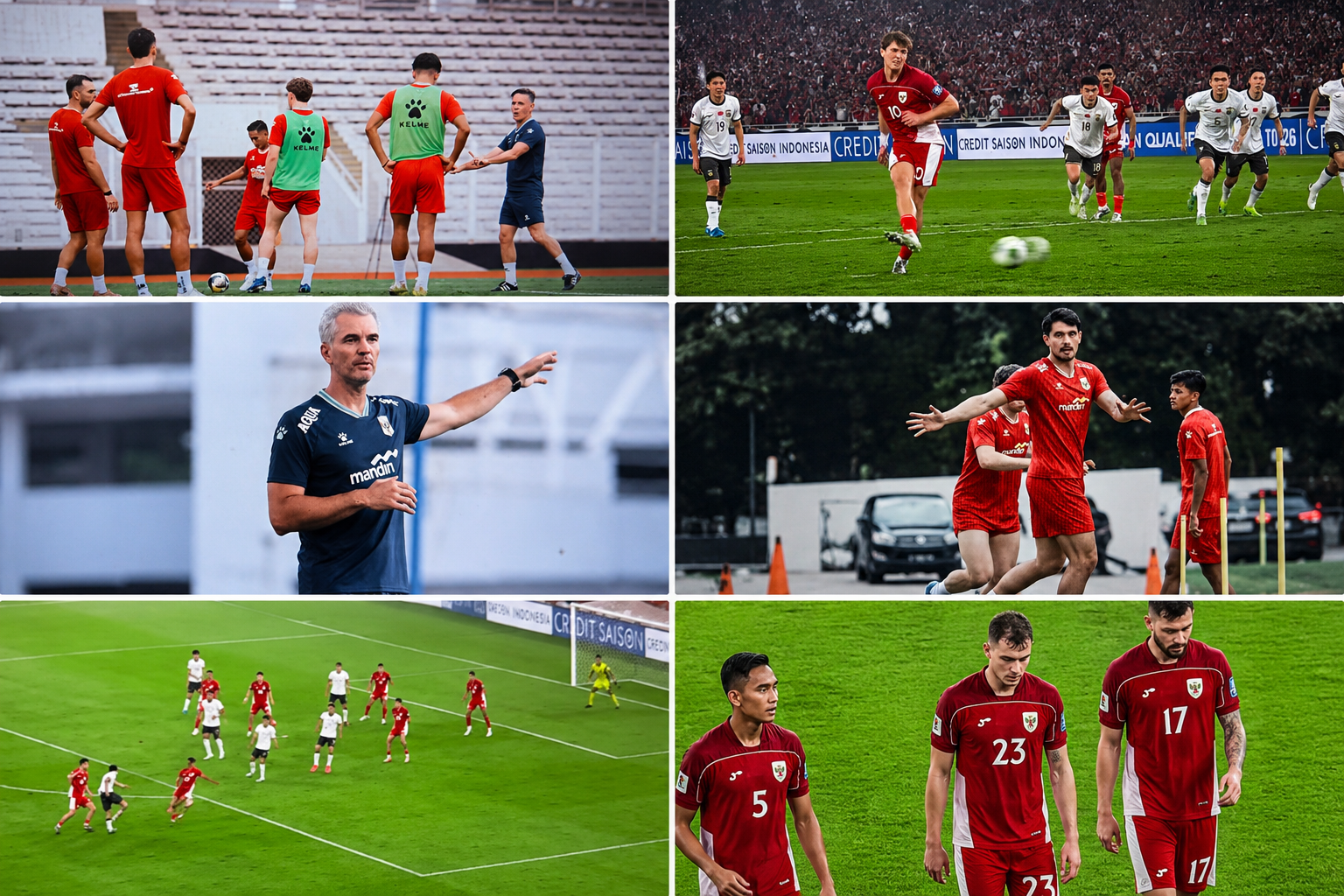
The Indonesia National Team is no longer viewed only through passion and atmosphere. Modern tactical structure, transition discipline, and aggressive pressing identity are beginning to redefine how Indonesia competes at international level.
Indonesia’s biggest development is not individual talent alone, but structural organization. Defensive spacing has improved, midfield rotation appears more coordinated, and transition recovery now happens faster than in previous tournament cycles.
Modern football increasingly rewards collective intelligence over isolated technical moments. Indonesia’s recent tactical direction shows an attempt to reduce chaos and increase controlled pressure phases across all lines.
One of the clearest tactical changes is the willingness to press higher up the pitch. Instead of waiting deep for long periods, Indonesia now attempts to disrupt buildup patterns earlier.
This creates momentum-driven phases where crowd energy, defensive aggression, and transition speed influence rhythm. For deeper context, explore our match intelligence analysis.
Indonesia becomes most dangerous during transition moments. Fast vertical movement, overlapping runs, and aggressive recovery pressing create phases where matches become tactically unstable for opponents.
This connects directly with league pressure intelligence and tournament positioning.
High-intensity matches often become emotionally charged environments. Referee control, foul sensitivity, and tempo management therefore become critical tactical variables.
More context can be found in our referee intelligence reports.
Indonesia’s football evolution now depends on tactical consistency rather than isolated emotional performances. The strongest football nations maintain structure under pressure, adapt during transitions, and control momentum across ninety minutes.
The long-term challenge is not only qualification or results, but building a sustainable football intelligence identity capable of competing against higher tactical levels internationally.
Tactical momentum, transition control, pressure phases, and structural match breakdowns.
Explore Analysis →Decision timing, spatial movement, and player influence inside match flow.
View Player Reports →Decision pressure, game control behavior, VAR context, and officiating influence.
Read Referee Context →How tactical volatility and momentum shifts affect league position and race dynamics.
Check Standings →Indonesian football is currently undergoing a massive transformation, and at the heart of this evolution is the strategic depth of the national team. In this analysis, we dive deep into the tactical nuances that define the current squad’s performance on the international stage.
Under the current management, the Indonesia national team has shifted towards a more modern, high-pressing system. The focus on transition play—moving quickly from a compact defensive block to a wide-attacking front—has become a hallmark of their recent matches.
The integration of versatile midfielders and wing-backs has allowed for a more flexible 3-4-3 or 5-4-1 formation, depending on the opposition. This flexibility is crucial for maintaining defensive solidity while ensuring that the strikers are not isolated during counter-attacks.
Stay tuned to MF. Nusantara for more in-depth breakdowns of player statistics, match formations, and the future of Indonesian football.
Tactical momentum, transition control, pressure phases, and structural match breakdowns.
Explore Analysis →Performance patterns, decision timing, spatial movement, and player influence inside match flow.
View Player Reports →Decision pressure, game control behavior, VAR context, and officiating influence in key phases.
Read Referee Context →How tactical volatility, pressure results, and momentum shifts affect league position and race dynamics.
Check Standings →