◆
Live data center: match signals updated across key football intelligence pages
◆
New referee impact layer tracks cards, fouls, VAR moments, and decision pressure
◆
Premier League standing data connected to form movement and performance context
◆
Tactical analysis reads beyond the scoreline: momentum, pressure, and game control
◆
Player analysis highlights efficiency, role impact, and decision-making patterns
◆
Mathic Field: football intelligence built for fast reading and deeper match context
◆
Live data center: match signals updated across key football intelligence pages
◆
New referee impact layer tracks cards, fouls, VAR moments, and decision pressure
◆
Premier League standing data connected to form movement and performance context
World Cup 2026 Briefing
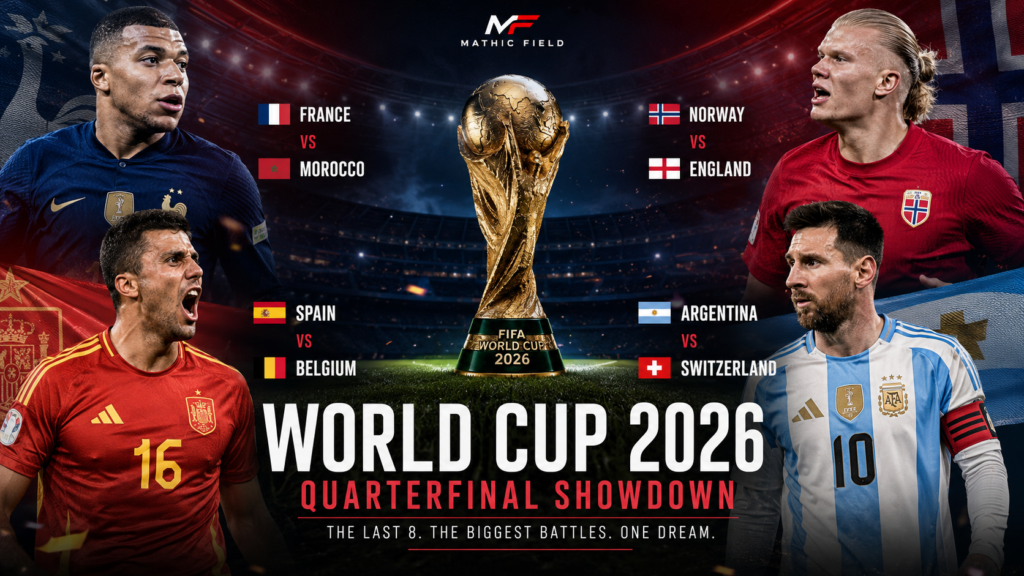
World Cup 2026 Quarterfinal Briefing: Momentum, Pressure, and the Last Eight
Mathic Field Analysis | Updated: July 9, 2026
The 2026 FIFA Men's World Cup has reached the quarterfinal stage, and the tone of the tournament has changed.
Brazil are out after Norway's shock victory, Portugal have been stopped by Spain, the United States were overwhelmed by Belgium,
and Argentina survived a dramatic knockout battle against Egypt.
The final eight are no longer separated only by star power. France bring efficiency, Morocco bring defensive discipline,
Spain bring structure, Belgium bring transition speed, Norway bring tournament momentum, England bring control,
Argentina bring survival instinct, and Switzerland bring tactical resilience.
Image idea: original editorial visual of World Cup quarterfinal atmosphere, stadium lights, mixed fans, no official FIFA logo, no real player face.
France vs Morocco: Two Different Identities, One High-Pressure Test
France against Morocco is the headline quarterfinal. France enter as one of the tournament favorites,
but Morocco are no longer just a romantic underdog story. After eliminating the Netherlands and Canada,
they arrive with belief, structure, and a clear tactical identity.
From a Mathic Field perspective, this match is not only about individual quality. The key zone is the space between midfield
and the full-back channels. If France move the ball quickly before Morocco's defensive block is fully set, they can create clean chances.
But if Morocco slow the match down and turn it into a compact, emotional contest, the pressure can shift back onto France.
Mathic Field Key Point
France need sharper efficiency in the final third. Morocco will not give away many open spaces,
so decision-making within the first three to five seconds after receiving the ball could define the match.
Spain vs Belgium: Structure Against Explosion
Spain look like one of the most organized teams left in the tournament. Their wins have followed a familiar pattern:
control, positional rotation, and patience. Belgium offer a different threat. They are more direct, more explosive,
and dangerous when attacking the space after a turnover.
This match could become a battle of tempo. If Spain keep the ball for long spells, Belgium may be forced into a tiring defensive block.
But if Belgium win possession in midfield, their transition speed can create major problems for Spain.
Image idea: tactical board, red and blue markers, midfield pressing lanes, cinematic dark sports-news style.
Norway vs England: The Tournament Surprise Meets Heavy Expectation
Norway have become one of the stories of the World Cup after knocking out Brazil.
But England present a different kind of challenge. Brazil offered space in key moments,
while England are more patient in controlling phases of play.
England cannot treat Norway like a normal underdog. A team that has already beaten Brazil carries strong psychological momentum.
In a match like this, the first goal could completely reshape the tactical script.
Argentina vs Switzerland: Champion Mentality Against System Resilience
Argentina remain alive after a dramatic knockout win over Egypt, but the quarterfinal against Switzerland demands a cleaner performance.
Switzerland are not easy to break emotionally. They can stay compact, frustrate opponents, and drag matches into decisive small moments.
For Argentina, the challenge is not only scoring first. The bigger issue is control after taking the lead.
If they allow Switzerland to extend the match into a tense final phase, the risk level rises quickly.
Match Intelligence
In the quarterfinal stage, the most stable team after the 70th minute can be more dangerous than the team that dominates early.
Late-match momentum is now a major tournament asset.
More From Mathic Field
For deeper football context, explore
Match Analysis,
follow live table context in Standing,
read player-focused insight through Player Analysis,
and visit MF Nusantara for an Indonesian football perspective.
Mathic Field Verdict
The World Cup 2026 quarterfinals are no longer about reputation alone.
They are about who reads pressure faster, who stays disciplined when momentum changes,
and who remains rational when one mistake can end an entire dream.
France may still look like one of the strongest candidates, but Morocco, Spain, Belgium, Norway,
England, Argentina, and Switzerland all have tactical reasons to believe.
At this stage, there are no easy wins left.